What Is Cradle to Cradle Certified? (What the Label Means)

Cradle to Cradle Certified is a product certification you may notice on everyday items, from building materials to textiles and packaging.
People look for it because it can be a helpful signal that a product was designed with safer materials and more responsible production in mind.
That matters in real homes because the things we bring indoors can influence day-to-day exposure and indoor air quality over time, which the EPA highlights in its overview of indoor air quality.
This article breaks down what the label actually means and how to use it as a practical decision tool, without overpromising what any single certification can do.
Cradle to Cradle Certified evaluates products for safer material choices and more circular, responsible design.
It evaluates products across multiple areas like material safety, reuse potential, and responsible production practices.
Use it as a helpful signal when choosing everyday items, not a perfect guarantee.
What Cradle to Cradle Certified Means (Simply)
Cradle to Cradle Certified is a third-party product certification that looks at how a product is designed, what it is made of, and how responsibly it is produced.
It is meant to reward products that are safer for people and better built for a circular economy (so materials can be reused instead of wasted).
This label is not a single-issue stamp. It is a multi-part certification that scores a product across several areas, including material safety and how the product’s materials can be reused.
What the label is (and is not)
It is:
- A certification for specific products (not a whole brand)
- A structured standard that checks more than one sustainability factor
- A way to compare products that are designed with circularity and material safety in mind
The label reflects multiple areas of review, not just one claim like “recyclable” or “eco-friendly.”
It is not:
- A guarantee that a product is “non-toxic,” “chemical-free,” or perfect for every home
- A shortcut that replaces reading basic product info (like how it is used, cleaned, or maintained)
- The same as “natural” or “eco-friendly” marketing language, which can be unverified
What It Evaluates (The 5 Categories You’re Actually Buying Into)
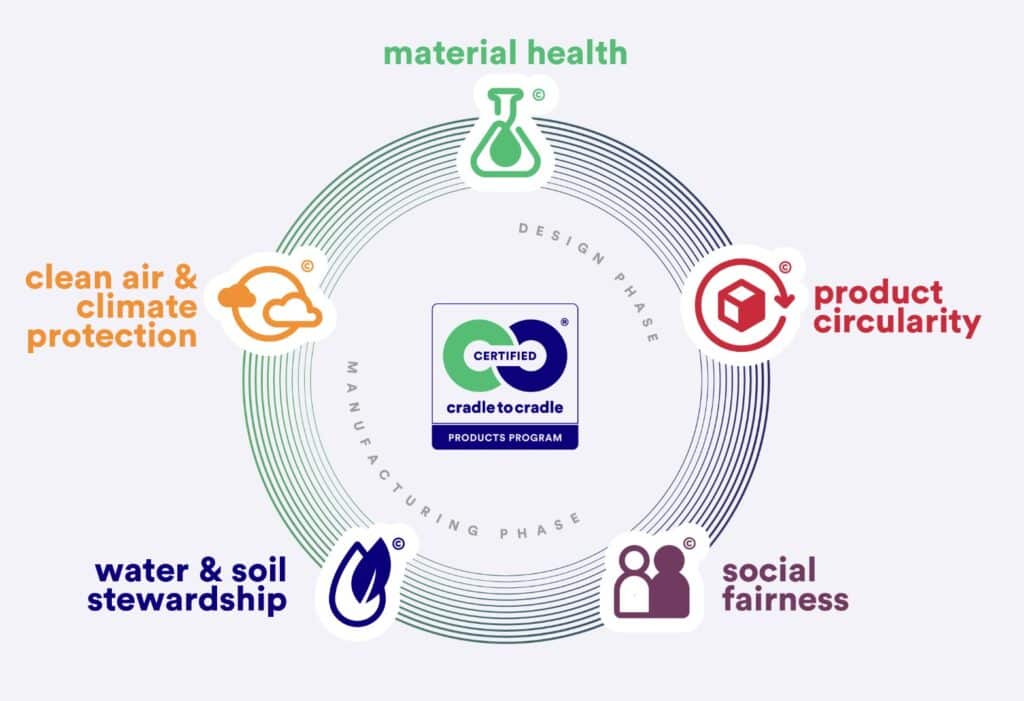
Cradle to Cradle Certified does not judge a product on just one “green” feature. It looks at five categories that cover what a product is made of, how it is produced, and what happens to it after use.
Think of it as a balanced scorecard. A product can be strong in one area and still have room to improve in another.
Material Health
This looks at the chemical makeup of the product and whether ingredients have been reviewed for safer use.
Material review means looking at what a product is made of, then pushing for safer alternatives where possible.
- Focus: identifying and improving concerning substances in the product
- Most relevant for: items used often, touched often, or used indoors (where VOC-related emissions can matter more)
Material Reutilization (Circularity)
This checks whether a product is designed for a next life, not just a first use.
- Focus: recycled content, recyclability, take-back systems, or design for disassembly
- Practical reminder: “recyclable” only helps if there is a realistic path to recycle it where someone lives
Renewable Energy & Carbon Management
This looks at the energy used to make the product and the company’s progress on cleaner energy.
- Focus: renewable energy use and carbon-related goals in manufacturing
- What it signals: the product’s production is being measured and improved, not ignored
If end-of-life is a big reason you’re choosing a product, check whether recycling or take-back is realistic where you live.
Water Stewardship
This reviews how water is used and protected during production.
- Focus: responsible water use, wastewater handling, and reducing pollution
- Most relevant for: products with water-intensive supply chains (common in some textiles and manufacturing)
Social Fairness
This addresses the human side of the supply chain.
- Focus: ethical treatment of workers, community impact, and responsible business practices
- What it signals: sustainability includes people, not just materials and energy
How to Use the Certification for Real-Life Decisions

Cradle to Cradle Certified is most useful when someone treats it like a signal, not a finish line.
The label can help narrow choices, then a shopper can still ask: “Does this fit how my family will actually use this at home?”
At The Goodness Well, we look at Cradle to Cradle as a strong “materials + design” indicator, and then we match it to real-life use.
Use the label to narrow your choices fast, then decide based on how your household will actually use the item.
What Cradle to Cradle is strongest at (best-fit use cases)
This certification tends to be most helpful for products where materials and manufacturing choices really shape the impact.
- Home and renovation materials (flooring, paint, insulation, countertops): long-term indoor use, large surface area
- Textiles and soft goods (rugs, upholstery fabrics, uniforms): complex materials and dyes, frequent contact
- Packaging-heavy items: when circular design and recovery systems matter
If a product is in the home for years or covers a big area, the “design and materials” side of this certification can carry more weight than it would for a small, occasional-use item.
Certifications tend to matter most when the product stays in your home for years or covers a large area.
Limitations, tradeoffs, and common misunderstandings
Cradle to Cradle Certified can still be misunderstood as a simple “safe” stamp. A few practical clarifiers help.
- Certified does not mean chemical-free. It means materials have been evaluated and the product is designed to improve over time.
- A product can do well overall and still have weaker spots. The certification looks across multiple categories, so performance can vary by category.
- End-of-life benefits depend on real systems. A product designed for recycling or take-back only works if someone can actually use those options.
A simple decision filter to use at home
When two products feel similar, use the label to focus the decision, not complicate it.
Start with how your household will interact with the product:
- Daily-contact or close-to-body items: prioritize the Material Health side of the certification and look for clear material transparency.
- Big, long-term home items: give extra weight to Material Health + Circularity, since the product sits in the home for years.
- Repeat-purchase items: prefer options that reduce waste and simplify disposal (less packaging, better reuse/recycling pathways).
Use Cradle to Cradle as a tie-breaker when:
- Price and performance are close
- Both options meet your basic needs (durability, function, maintenance)
- You want a more credible signal than “eco-friendly” language
REAL-LIFE EXAMPLE

A family is choosing between two similar rugs at the same price. One is Cradle to Cradle Certified and clearly explains its materials and circular design goals. They choose the certified rug, then focus on practical factors that matter at home, like cleaning needs and how it will hold up in a high-traffic room.
Conclusion
Cradle to Cradle Certified is a helpful way to spot products that have been evaluated for safer material choices and more responsible, circular design.
It works best as a strong signal when you want something beyond vague “eco” claims, especially for items your household uses often or keeps for a long time.
It is not a perfect guarantee, and it cannot replace common-sense fit for your home.
When you use it as a guide, then pair it with practical needs like durability, ease of care, and budget, it becomes a calm, reliable tool for choosing better without getting stuck in research.