The 7 Best Non-Toxic Nursery Furniture Brands For Every Budget (Reviewed)





Creating a nursery often means bringing several new furnishings into one room where a baby will spend many hours sleeping and playing.
That makes material choices especially important, since furniture can introduce indoor pollutants through pressed wood, adhesives, paints, stains, finishes, and other chemical treatments.
The EPA notes that new pressed-wood products can raise indoor formaldehyde levels, while other furniture materials and finishes may also contribute to indoor VOC exposure.
Choosing the best non-toxic nursery furniture requires looking beyond broad safety claims to consider materials, construction, finishes, chemical treatments, durability, certifications, and overall value.
This guide compares nursery essentials to help families find safer options that suit their space, needs, and budget.

The Goodness Well is reader-supported. Some links in this article may be affiliate links, but every recommendation follows our editorial standards and independent review process. Learn more about our editorial standards and review methodology.
What “Non-Toxic” Really Means

“Non-toxic” has no single definition across nursery furniture. Treat it as a starting claim, then look for details about materials, finishes, adhesives, foam, and testing.
A safer product should explain what it contains and what it avoids. Specific disclosures carry more weight than phrases such as “natural,” “eco-friendly,” or “baby-safe.”
Start With Full Disclosure
Check whether safety information applies to the entire product or only one component. A crib may be certified while its mattress, guardrail, or coordinating dresser is not.
Look for clear answers to these questions:
- What wood or composite is used?
- Are adhesives and finishes identified?
- Does upholstery contain polyurethane foam?
- Are flame retardants or PFAS disclosed?
- Which exact products are certified?
We also looked for these distinctions when comparing the recommendations in this guide. Brands received more credit for product-level details than broad company-wide claims.
Look Past Furniture Odors
Off-gassing occurs when materials release volatile chemicals into the air. Common sources include paints, stains, adhesives, engineered-wood resins, foam, and treated fabrics.
A strong odor can signal emissions, but smell is not a reliable safety test. Products may release chemicals without producing a noticeable scent.
New pressed-wood furniture deserves closer attention because adhesives can contain formaldehyde. Products meeting federal composite-wood requirements must follow EPA formaldehyde emission standards, but compliance does not mean zero emissions.
If possible, assemble furniture before the nursery is needed. Open windows, increase airflow, and allow odors to clear before use. Ventilation helps reduce indoor concentrations but does not replace careful material selection.
Materials Worth Comparing

Solid wood usually provides a simpler construction to evaluate than particleboard or medium-density fiberboard. It often uses fewer bonded wood particles, but the finish, paint, and glue still matter.
Engineered wood is not automatically unsuitable. It can lower costs and improve stability, making safer nursery furniture more affordable. Look for the exact wood type, TSCA Title VI compliance, and clear information about coatings and adhesives.
Check both the furniture core and surface finish. Solid wood can still contain paints, stains, or adhesives that affect emissions.
Match Materials to Use
Different nursery items require different questions:
- Cribs: Wood, finish, adhesives, conversion parts
- Dressers: Core materials, drawer construction, anchors
- Gliders: Foam, fabric treatments, flame retardants
- Mattresses: Fill, waterproofing, PFAS, fire barriers
- Changing pads: Foam, covers, waterproof layers
For painted furniture, “water-based,” “low-VOC,” and “zero-VOC” describe different attributes. None confirms the safety of every ingredient. A manufacturer should identify the finish and explain any substances intentionally excluded.
Mattresses and upholstered seating need separate scrutiny because their foam and fabric may differ from the furniture frame. Buyers avoiding polyurethane foam can look for clearly identified latex, cotton, or wool constructions.
When foam is used, check its certification and ask about flame retardants, fiberglass, and stain-resistant treatments.
Durability also affects value. Replaceable parts, sturdy drawer hardware, and available conversion kits may extend useful life. However, a convertible crib only saves money when every required rail is available and reasonably priced.
Certifications That Help
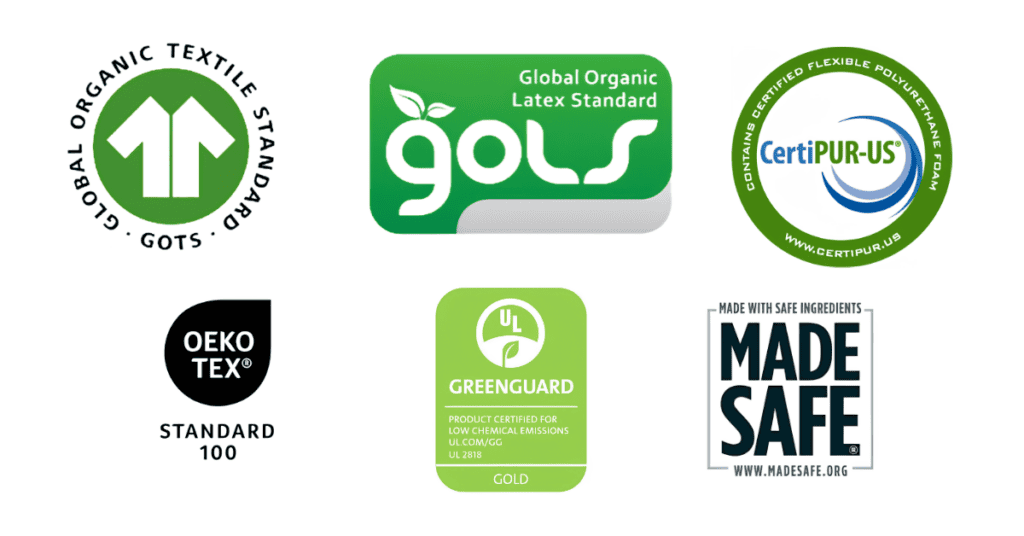
Certifications answer specific questions rather than proving a product is entirely chemical-free. The most useful label depends on whether you are evaluating emissions, wood sourcing, textiles, latex, or foam.
Verify the Exact Product
Here is what common certifications can tell shoppers:
- GREENGUARD Gold: Tests products against stricter chemical-emission limits. UL Solutions identifies it for sensitive settings, including nurseries.
- FSC: Tracks wood from certified, recycled, or controlled sources. FSC labels address forest sourcing, not indoor emissions.
- GOTS: Covers certified organic fibers and textile processing requirements. Check for the label grade and certification details on the finished item.
- GOLS: Applies to certified organic latex and its processing chain. It does not certify unrelated furniture components.
- CertiPUR-US: Evaluates flexible polyurethane foam for specified content, emissions, and durability criteria. The program clarifies that it certifies foam, not the finished product.
Key Takeaway: Each certification covers specific materials or standards, so verify the exact product and certification scope.
Always match the certification to the model or component being purchased. A badge on a collection page may cover one crib, mattress, or fabric rather than every item shown.
Balance this evidence with price and function. A well-documented engineered-wood crib may be more useful than an unaffordable solid-wood model with vague finish information.
The stronger purchase is the one that combines transparent materials, relevant product-level testing, safe construction, and features your family will actually use.
The Best Non-Toxic Nursery Furniture Brands

dadada
Dadada is our top pick because it offers GREENGUARD Gold-certified solid wood cribs at more affordable prices than many of the other top nursery brands.
Every crib is made in Italy from kiln-dried, 100% solid European beechwood and finished with non-toxic, baby-safe materials.
The lineup includes 3-in-1, 4-in-1, and 8-in-1 designs that can adapt as your child grows, although some conversion kits are sold separately.
Its locally sourced renewable wood, fair labor practices, and partnership with furniture-resale platform REBEL also strengthen its sustainability credentials.
One downside is that some non-crib furniture contains engineered wood, and the same GREENGUARD Gold claim does not appear to cover every product category.
Product Highlights:
- Price: $459–$999 at regular price
- Materials: Kiln-dried, 100% solid European beechwood for cribs; engineered wood used in some other furniture
- Finish / Adhesives: Non-toxic, baby-safe finishes; adhesives not clearly disclosed
- Certifications: All cribs are GREENGUARD Gold Certified
- Safety: Lead-free, formaldehyde-free, phthalate-free, and made without added PFAS or PFOA
- Functionality: 3-in-1, 4-in-1, and 8-in-1 convertible designs; some conversion kits sold separately
- Sustainability: Locally sourced renewable wood, low-impact production, fair labor practices, and furniture resale through REBEL
- Made In: Italy
- Warranty: Two years for cribs; one year for other furniture purchased through an authorized retailer
- Best For: Solid wood, low-emission cribs that balance quality, design, and price
- Downside: Some non-crib pieces use engineered wood and may not carry GREENGUARD Gold certification

Green Cradle
If materials and transparency matter more than budget, Green Cradle is the strongest nursery furniture brands in this roundup.
Its furniture is handcrafted in the USA from locally sourced solid hardwood, without MDF, plywood, veneers, or particleboard.
Buyers can choose from five wood types and either leave the furniture unfinished or add the brand’s zero-VOC natural oil finish.
This makes Green Cradle an excellent choice for families who want real wood nursery furniture with fewer glues, synthetic finishes, and potential sources of off-gassing.
The biggest drawback is the luxury pricing, and the information shown does not clearly confirm that these specific pieces are GREENGUARD Gold Certified.
Product Highlights:
- Price: $1,099–$5,549 at regular price
- Materials: 100% solid hardwood; no MDF, plywood, veneers, or particleboard
- Wood Options: Brown maple, cherry, hard maple, red oak, and walnut
- Finish / Adhesives: Unfinished or zero-VOC natural oil finish; no specific adhesive disclosed
- Certifications: GREENGUARD Gold information provided, but certification of these specific products is not clearly confirmed
- Product Range: Cribs, changing tables, nightstands, armoires, bedroom furniture, mattresses, and bedding
- Sustainability: Locally sourced wood and long-lasting, repairable construction
- Made In: USA
- Best For: Families prioritizing natural materials and detailed material transparency
- Downside: Considerably more expensive than the other brands in this roundup

Storkcraft
Storkcraft offers a more affordable route to certified nursery furniture than the premium solid wood brands above.
Its broad lineup includes convertible cribs, dressers, changing products, mattresses, storage, and nursery seating, with many items carrying GREENGUARD Gold certification.
Every crib is designed to convert into a toddler or larger bed, while newer dressers include an interlocking drawer system and tip-over restraint.
The certified models are a good fit for families who want lower-emission nursery products without paying luxury prices.
The main tradeoff is that materials and certifications vary by model, and some furniture uses veneers, composites, or other engineered wood products.
Product Highlights:
- Price: $24.99–$799.99
- Materials: Solid wood, veneers, composites, and other wood products; construction varies by model
- Finish / Adhesives: Not clearly disclosed in the provided information
- Certifications: GREENGUARD Gold available across many product categories; certification must be checked by model
- Safety: All cribs, mattresses, changing pads, toddler guardrails, toddler beds, and changing tables are Baby Safety Alliance Verified
- Functionality: Convertible cribs, changing toppers, storage drawers, power recliners, and dressers with interlocking drawers
- Sustainability: Supports reforestation projects through One Tree Planted
- Best For: Affordable certified nursery furniture with practical grow-with-me features
- Downside: Some products contain engineered wood, and not every item has the same certifications

Delta Children
Few brands in this roundup cover as much ground as Delta Children, with options ranging from cribs and nursery sets to gliders, mattresses, bassinets, and playroom furniture.
The brand uses renewable New Zealand pine in some products, and its convertible designs help families use the same furniture for longer.
Many wood products and all mattresses are GREENGUARD Gold Certified, while every product is described as free from added toxic flame retardants, lead, and phthalates.
The certified models are a practical choice for families who want lower-emission nursery furniture with plenty of styles and price points to choose from.
The downside is that certifications, materials, and finishes vary by model, so each product page needs to be checked carefully.
Product Highlights:
- Price: $1,360–$1,890 at regular price for the visible nursery collections
- Materials: High-quality woods and fabrics; renewable New Zealand pine used in some products
- Finish / Adhesives: Exact finishes and adhesives not clearly disclosed
- Certifications: All mattresses and many wood products are GREENGUARD Gold Certified; coverage varies by model
- Safety: Free from added toxic flame retardants, lead, and phthalates; tested to applicable BSA, CPSIA, and ASTM standards
- Functionality: Cribs convert into full-size beds; some changing tables become dressers or bookshelves
- Sustainability: Renewable wood, long-lasting multi-use designs, and reduced need for replacement furniture
- Best For: Families wanting a broad selection of affordable, certified nursery products
Downside: Materials and certifications are not consistent across the entire range

Bellini
Bellini focuses on high-end nursery design, with coordinated collections combining furniture, bedding, and seating in customizable bundles.
Depending on the collection, shoppers can select a crib, dresser, changing top, guardrail, mattress, glider, and sheets.
Materials vary by product. Examples include poplar, ash wood, ash veneer, TSCA-compliant engineered wood, felt, and recyclable acrylic.
Bellini uses a non-toxic, multi-step painting process described as lead- and phthalate-safe.
Select products are GREENGUARD Gold Certified. Cribs and guardrails may also carry JPMA certification and meet or exceed applicable CPSC and ASTM standards. Some dressers include tip-over restraints and comply with ASTM F2057 requirements.
Bellini offers useful features such as convertible cribs, adjustable mattress heights, built-in storage, soft-close drawers, assembled dressers, and removable changing trays.
However, materials and certifications vary, so shoppers should review each product individually.
Product Highlights:
- Price: $4,340–$5,330 at regular retail price
- Materials: Poplar, ash, veneer, engineered wood
- Finish: Non-toxic, lead- and phthalate-safe
- Certifications: GREENGUARD Gold on select products
- Safety: JPMA, CPSC, and ASTM compliance
- Functionality: Convertible cribs and customizable bundles
- Storage: Built-in drawers and soft-close dressers
- Best For: Coordinated luxury nursery collections
- Downside: Materials and certifications vary

Nestig
Nestig stands out for playful nursery furniture that can adapt as a child grows. Its convertible cribs move from a mini crib to a full-size crib and toddler bed, while the wider collection includes dressers, seating, side tables, and children’s furniture.
Several best-selling cribs are GREENGUARD Gold Certified, and all Nestig cribs are JPMA certified, Prop 65 compliant, and tested to applicable CPSC and ASTM standards.
The brand also uses wood from reforested land and keeps inventory low to reduce the carbon footprint associated with excess stock.
These practices give Nestig an eco-friendly angle, but some products contain engineered components, synthetic upholstery, or polyurethane-foam mini mattresses, and certification coverage varies.
It is a stylish, flexible option, although prices are high and shoppers should check the materials and certifications for each model.
Product Highlights:
- Price: $159–$1,599
- Materials: Sustainably sourced wood from reforested land; engineered components, synthetic upholstery, and polyurethane-foam mini mattresses used in some products
- Finish / Adhesives: Not clearly disclosed
- Certifications: Wave, Cloud, Candy Cloud, Woodland Cloud, and Wave Crib in Color are listed as GREENGUARD Gold Certified; all cribs are JPMA certified
- Safety: Prop 65 compliant and tested to applicable CPSC and ASTM standards
- Functionality: Convertible cribs transform from mini crib to full-size crib and toddler bed
- Sustainability: Low-inventory business model, reforested wood sources, and ethical production
- Manufacturing: Handcrafted in a family-run factory under supportive working conditions
- Best For: Design-focused families wanting versatile, grow-with-me nursery furniture
- Downside: Premium pricing, engineered materials, and uneven GREENGUARD Gold coverage

Naturepedic
Naturepedic earns a different kind of spot in this roundup as our best organic crib mattress option.
Unlike the brands above, it offers crib mattresses and changing pads rather than cribs, dressers, or other nursery furniture.
Its mattresses use materials such as certified organic cotton and wool, GOTS-approved latex, plant-based PLA, FSC-controlled wood, and recycled steel coils, depending on the model.
Finished mattresses are GOTS certified and carry rigorous certifications that include MADE SAFE, EWG Verified, and GREENGUARD Gold.
Naturepedic is an excellent match for a lower-tox nursery, but families will still need to purchase their actual furniture from another brand.
Product Highlights:
- Price: $49–$459 at regular price
- Materials: Organic cotton and wool, GOTS-approved latex, plant-based PLA, FSC-controlled wood, and recycled steel coils
- Construction: Lightweight and innerspring options; breathable and two-stage designs available
- Certifications: GOTS, GOLS where applicable, MADE SAFE, EWG Verified, and GREENGUARD Gold
- Safety: No polyurethane foam, chemical flame retardants, fiberglass, vinyl, phthalates, formaldehyde, or PFAS
- Functionality: Standard, mini, oval, and bassinet sizes; waterproof, breathable, and two-stage options
- Sustainability: Recycled steel and polyethylene, reused or donated material scraps, FSC paper packaging, and a zero-waste goal for 2027
- Made In: Chagrin Falls, Ohio, in a GOTS-certified organic factory
- Warranty / Shipping: Free shipping, 100-night trial, and free returns shown
- Best For: Certified organic crib mattresses made without polyurethane foam or chemical flame retardants
- Downside: Does not offer cribs, dressers, or other nursery furniture