What Certifications Should a Non-Toxic Mattress Have? Labels That Actually Matter

Mattress certifications can make picking out a true non toxic mattress feel easier, but they can also be confusing when every label seems to promise something different.
The most useful labels do not all test for the same thing: some focus on organic materials, some on chemical emissions, and others on specific substances used in fabrics or foam.
Because the Federal Trade Commission’s Green Guides are designed to help prevent misleading environmental claims, it is worth looking beyond the badge and asking what the certification actually verifies.
This guide breaks down the mattress certifications that matter most, where each one has limits, and how to use them alongside a brand’s full material list.
Look for GOTS, GOLS, GREENGUARD Gold, OEKO-TEX STANDARD 100, and CertiPUR-US.
Organic cotton and wool should have GOTS, organic latex should have GOLS, memory foam should have CertiPUR-US, and GREENGUARD Gold or OEKO-TEX can provide additional assurance for low emissions and harmful substance testing.
Best Mattress Certifications
The best mattress certifications are the ones that match the materials inside the mattress.
A latex mattress, a memory foam mattress, and a hybrid mattress should not be judged by the exact same labels. Each material has different testing needs.
For a non-toxic mattress, the most useful certifications usually fall into a few categories:
- Organic material certifications for cotton, wool, and latex
- Low-emission certifications for VOCs and indoor air quality
- Foam certifications for polyurethane foam and memory foam
- Textile safety labels for fabrics, covers, and sewn components
- Ingredient-screening certifications for broader chemical review
This matters because some mattress materials release chemicals into indoor air after production.
A PubMed Central review notes that fresh polyurethane flexible foams, including foams used in bed mattresses, emit VOCs and that emissions usually decline over time.
At The Goodness Well, we look at certifications as helpful tools, not shortcuts for reading the full material list.
Here is the simple way to think about the main mattress certifications:
- GOTS is most useful for organic cotton and wool.
- GOLS is most useful for organic latex.
- GREENGUARD Gold is most useful for low chemical emissions.
- CertiPUR-US is most useful for polyurethane foam and memory foam.
- OEKO-TEX STANDARD 100 is most useful for textile chemical testing.
- MADE SAFE is useful when you want broader ingredient screening.
A mattress does not need every certification to be a better choice. A brand that uses organic latex may prioritize GOLS and GOTS. A memory foam brand may focus more on CertiPUR-US and emissions testing.
The strongest choice is usually a mattress with certifications that match its materials, plus a clear explanation of what is inside each layer.
Key Takeaway: The best certification mix depends on what the mattress is actually made of.
Organic Material Certifications
Organic material certifications are most useful when a mattress uses natural fibers or latex.
These labels help verify that the material is not just described as “natural” or “eco-friendly.” They show that the material followed a specific organic standard.
GOTS for Cotton and Wool
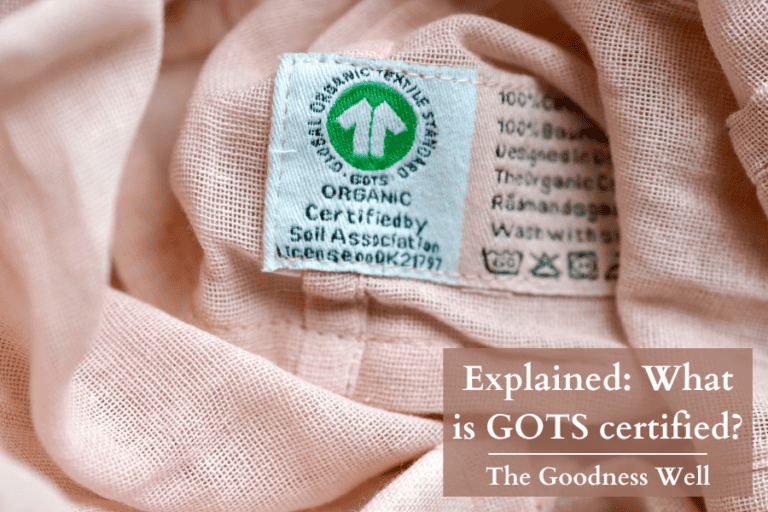
GOTS stands for Global Organic Textile Standard. It applies to organic textile materials, including cotton and wool.
When a mattress says “organic,” check whether the certification applies to the cover, the filling, or the entire finished mattress.
For mattresses, this usually matters for covers, quilted layers, batting, and wool flame barriers.
GOTS looks at more than the farm source. It also covers processing steps, environmental rules, and third-party certification through the supply chain.
Look for GOTS when a mattress claims to use:
- Organic cotton covers
- Organic wool batting
- Organic textile layers
- Wool used as a natural flame barrier
GOTS does not certify latex foam itself. If a mattress has organic cotton and wool plus a latex core, GOTS only applies to the textile parts unless the finished mattress has broader GOTS certification.
GOLS for Organic Latex
GOLS stands for Global Organic Latex Standard. It applies to products made with organically grown natural rubber latex.
This label matters most for latex mattresses. It helps verify that the latex comes from organic rubber sources and follows a latex-specific standard.
Look for GOLS when a mattress claims to use:
- Organic latex
- Natural rubber latex
- Latex comfort layers
- Latex support cores
GOLS does not automatically cover cotton, wool, fabric, coils, or adhesives. Those parts need their own details or certifications.
For example, a latex mattress may use GOLS-certified latex and GOTS-certified cotton or wool. That combination tells you more than a vague “organic mattress” claim.
Emissions and Indoor Air

Emissions certifications look at what a mattress releases into indoor air.
This is different from checking whether a material is organic. A mattress can use organic fibers and still need emission testing for the finished product.
The main concern here is VOCs. These are chemicals that evaporate into the air from some materials and manufacturing processes.
VOCs are chemicals that evaporate into the air from certain materials. Emissions testing checks how much of those chemicals a product releases.
The EPA explains that VOCs can be released from certain solids and liquids, and indoor levels are often higher than outdoor levels.
For mattresses, emissions testing is useful because the mattress sits in a bedroom every day. You also sleep close to it for hours at a time.
GREENGUARD Gold
GREENGUARD Gold is one of the most useful certifications for mattress emissions.
It tests products for low chemical emissions. GREENGUARD Gold has stricter limits than standard GREENGUARD, especially for spaces used by children and sensitive groups.
This certification is most helpful when you want to reduce strong new-mattress smells and VOCs in the bedroom.
GREENGUARD Gold does not mean a mattress is organic. It also does not tell you every material inside the mattress. It mainly answers this question: “Does this product meet low-emission limits?”
GREENGUARD Gold has stricter emission limits than standard GREENGUARD, which is why it is often preferred for bedrooms and children’s spaces.
Formaldehyde Standards
Formaldehyde is a VOC that can show up in some home products, especially where certain adhesives, resins, or textile finishes are used.
For mattresses, formaldehyde-related standards matter most when the product uses:
- Adhesives between layers
- Treated fabrics
- Finished textile components
- Fiberboard or wood parts in adjustable bases
Some brands use labels such as formaldehyde-free, no added formaldehyde, or formaldehyde-tested. These claims are more useful when they are backed by third-party testing.
A formaldehyde-related claim does not replace full mattress transparency. Ask what adhesive is used, whether the fabrics are treated, and whether the finished mattress has emission testing.
Foam and Textile Labels
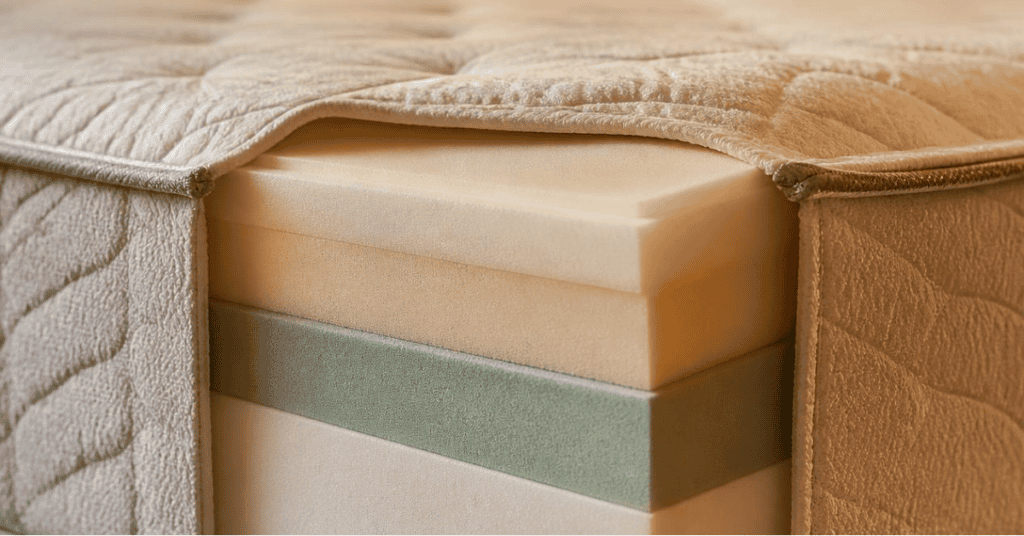
Foam and textile labels help when a mattress uses synthetic foam, fabric covers, thread, or other sewn materials.
These certifications do not prove that a mattress is organic. They are mainly useful for checking certain chemical limits in foam and textile parts.
CertiPUR-US
CertiPUR-US applies to flexible polyurethane foam. This includes many memory foam and polyfoam mattresses.
This label means the foam meets specific standards for certain chemicals and emissions.
According to CertiPUR-US, certified foam is made without formaldehyde, ozone depleters, certain phthalates, and several heavy metals. It must also meet a low VOC emissions limit.
CertiPUR-US is most useful when a mattress contains:
- Memory foam
- Polyfoam comfort layers
- Polyurethane foam support layers
CertiPUR-US does not mean the foam is natural or organic. It also does not certify cotton, wool, latex, coils, or the full mattress construction.
A memory foam mattress with CertiPUR-US is still a synthetic foam mattress.
OEKO-TEX STANDARD 100
OEKO-TEX STANDARD 100 applies to textiles. For mattresses, that can include fabric covers, yarn, thread, and other textile pieces.
OEKO-TEX describes STANDARD 100 as a label for textiles tested for harmful substances, from yarn to finished product.
This label is most useful when you want more information about:
- Mattress covers
- Fabric panels
- Sewing thread
- Textile trims
- Quilted fabric layers
OEKO-TEX STANDARD 100 does not mean the fabric is organic. It also does not replace GOTS for organic cotton or wool claims.
Use OEKO-TEX as a textile safety check. Then look separately for the fabric source, full material list, and any added treatments.
Use OEKO-TEX to check textile safety, then look separately for the fabric source and any added treatments.
Broader Safety Certifications
Some certifications look beyond one material type. They review ingredients across the product instead of focusing only on cotton, latex, foam, or fabric.
This is where MADE SAFE is most useful.
MADE SAFE
MADE SAFE is a broader product certification focused on ingredient screening. It reviews products against the MADE Banned List, which includes more than 15,000 restricted substances.
For mattresses, MADE SAFE is helpful when you want screening for chemical groups such as:
- Hazardous flame retardants
- Certain heavy metals
- High-risk pesticides
- Toxic solvents
- Harmful VOCs
A mattress can still be well-made without MADE SAFE. Some brands use other third-party testing instead.
These ingredient groups are studied because some chemicals can interfere with normal body systems. For example, the NIH explains that endocrine-disrupting chemicals can mimic, block, or interfere with hormones.
MADE SAFE does not mean every mattress without it is unsafe. Some brands use strong materials and third-party testing but do not pursue this separate certification.
If a mattress has MADE SAFE, still check the full material list. Look for clear details on the cover, comfort layers, support core, flame barrier, and adhesives.
How to Use Certifications

Use mattress certifications as a matching tool. Start with the mattress type, then look for the labels that fit those materials.
A mattress does not need every certification to be a strong choice. It needs the right certifications for what it is made of.
Here is a simple way to compare them:
- Organic latex mattress: Look for GOLS for latex and GOTS for cotton or wool.
- Organic hybrid mattress: Look for GOTS or GOLS on natural layers, plus emissions testing.
- Memory foam mattress: Look for CertiPUR-US and a low-emission certification.
- Textile-heavy mattress: Look for GOTS or OEKO-TEX on covers and fabric layers.
- Mattress with broad “non-toxic” claims: Look for MADE SAFE or clear third-party testing.
Start with the mattress type first. Then look for the certifications that match the materials inside it.
Also check what each certification applies to. Some labels cover one component, such as the latex, foam, or fabric cover. Others may apply to the finished mattress.
Before buying, look for these details:
- The full layer-by-layer material list
- The type of flame barrier used
- Whether adhesives are used between layers
- Any stain, water, or antimicrobial treatments
- Whether the certification applies to one part or the whole mattress
- The brand’s testing documents or certificate numbers
Be careful with broad claims like “green,” “natural,” or “eco-friendly” when the brand gives few details.
The FTC Green Guides explain that environmental claims should be clear and supported, not vague.
Key Takeaway: Certifications are most helpful when they are paired with a clear, layer-by-layer material list.
FAQ
No, CertiPUR-US only applies to polyurethane foam, so you should also consider the mattress’s other materials and certifications.
Neither is better—they test different things, and having both provides more comprehensive assurance.
Not always, but mattresses with organic textiles should have GOTS, while those with organic latex should have GOLS.
No, OEKO-TEX tests for harmful substances, while organic certifications verify how materials are grown and produced.
Yes, a mattress can still be a good non-toxic choice if it uses safe materials and provides transparent information, even without every certification.