GREENGUARD Certified vs GREENGUARD Gold: What’s the Difference?

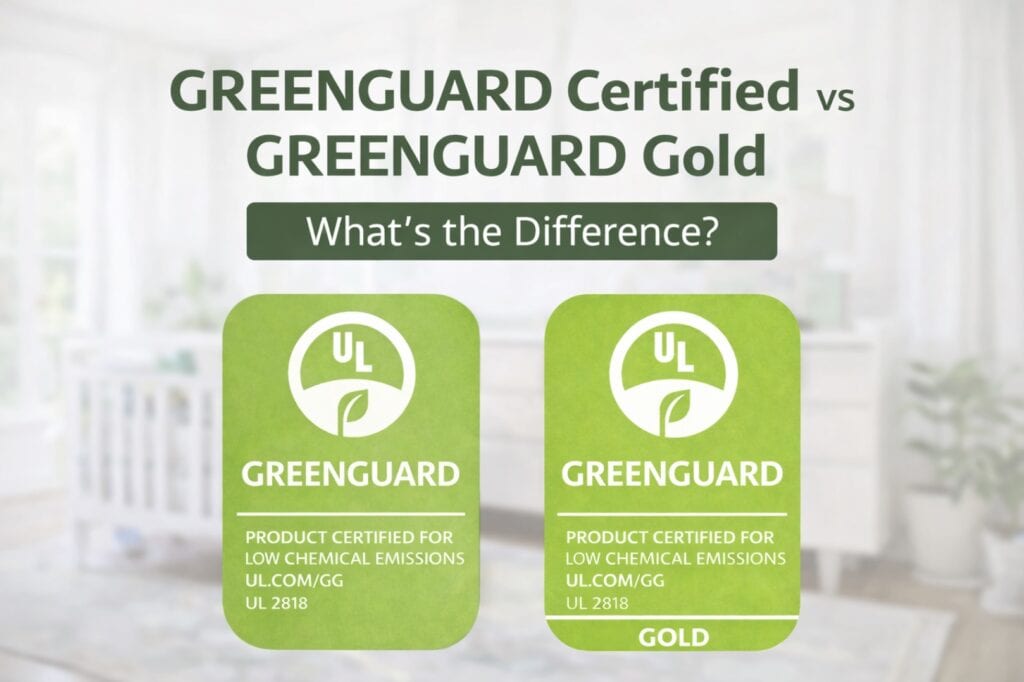
If you are shopping for furniture, a crib mattress, flooring, or paint, you have probably seen the words “GREENGUARD Certified” and “GREENGUARD Gold” and wondered whether they are basically the same.
The difference matters because many everyday products can release volatile organic compounds (VOCs) into indoor air over time, and indoor exposure can add up, especially in the rooms where you sleep or where kids spend hours playing.
This guide will help you understand what each label is actually telling you, without marketing fluff. The goal is simple: make it easier to choose the level that fits your home, your budget, and your comfort level.
GREENGUARD Gold is a stricter version of GREENGUARD Certified for lower indoor air emissions.
Both labels signal a product is designed to release fewer VOCs into your home over time.
Gold is often the better pick for bedrooms, nurseries, and other high-use spaces.
What GREENGUARD Actually Measures
GREENGUARD certification is about indoor air emissions from a finished product — not ingredient purity or marketing claims.
Products are placed in controlled environmental chambers and tested to measure how many chemicals they release into indoor air over time.
The program focuses on emissions limits, meaning it evaluates what a product releases into indoor air after manufacturing, especially when off-gassing is most noticeable.
Off-gassing is the slow release of chemicals into the air from a finished product, especially when it’s new.
The primary concern is volatile organic compounds (VOCs).
VOCs are chemicals that can evaporate into the air at room temperature and contribute to that familiar “new furniture” or “fresh paint” smell.
Some VOCs can affect indoor air quality, particularly in enclosed spaces where people spend many hours each day.
What this certification does not mean:
- It does not mean the product is “non-toxic.”
- It does not mean “chemical-free.”
- It does not mean “zero VOC.”
- It does not evaluate every ingredient for health impact.
- It does not guarantee that no smell will occur.
Instead, it means the product met established low-emissions standards for indoor air quality under the GREENGUARD program criteria.
Key Takeaway: Think of GREENGUARD as an air-quality filter that helps reduce how much a product contributes to indoor VOC levels. It does not certify that every material inside the product is inherently “clean” or risk-free.
GREENGUARD vs GREENGUARD Gold Explained Simply
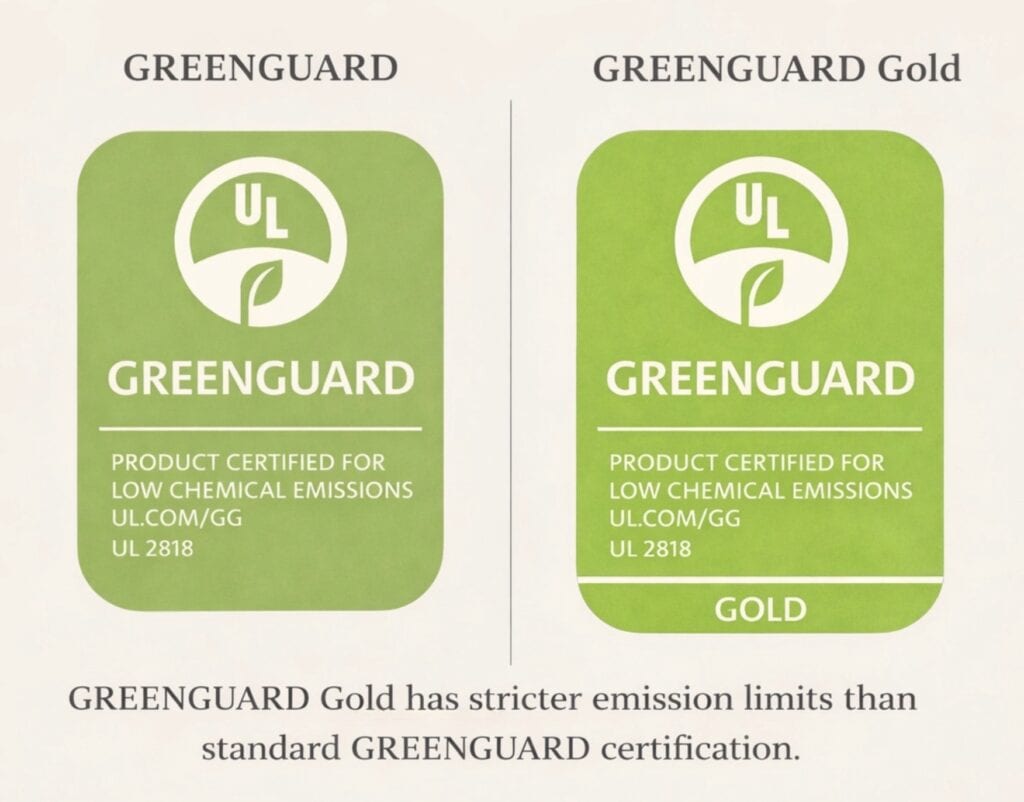
The difference between GREENGUARD Certified and GREENGUARD Gold comes down to how strict the emissions limits are.
Both certifications test products for indoor air emissions, but GREENGUARD Gold requires lower allowable VOC emissions than standard GREENGUARD Certified. In simple terms, Gold sets a tighter threshold.
Other programs, such as SCS Indoor Advantage Gold, also focus on low indoor air emissions but use different testing frameworks and criteria.
For example, one commonly cited benchmark for total VOC emissions is:
- GREENGUARD Certified: up to 500 μg/m³
- GREENGUARD Gold: up to 220 μg/m³
That stricter limit is why Gold is often marketed for nurseries, schools, healthcare settings, and other sensitive environments where people spend long hours and where children are present.
At The Goodness Well, we treat Gold as the “extra margin of safety” label for the spaces where people are most vulnerable or spend the most time.
Key Takeaway: Both labels signal low-emitting products, but Gold represents a stricter standard designed for higher-exposure or more sensitive spaces.
Which One Should You Choose?

If you want a simple rule of thumb, use the stricter label where exposure is highest.
Bedrooms and nurseries → GREENGUARD Gold
These are smaller spaces where doors are often closed and where people spend long, uninterrupted hours. Items like mattresses, cribs, upholstered beds, and large rugs are higher-priority candidates for Gold.
General living areas → Standard GREENGUARD may be sufficient
In larger, well-ventilated spaces like open living rooms or offices, standard GREENGUARD Certified products can provide a reasonable low-emissions baseline.
Budget considerations
If cost is a factor, prioritize Gold for one or two high-impact items in sleep spaces, and use standard GREENGUARD for the rest.
REAL-LIFE EXAMPLE

A parent is choosing a crib mattress and a dresser for a small nursery. Picking GREENGUARD Gold helps reduce the chance those big, new items will add as much VOC “new product smell” to a closed-door room where a baby sleeps for many hours.
Conclusion
GREENGUARD Certified and GREENGUARD Gold are both helpful labels for lowering indoor air emissions from everyday products, with Gold being the stricter option when you want the tightest standard for spaces like bedrooms and kids’ rooms.
Neither label means “chemical-free” or “zero emissions,” but both provide a more reliable baseline than marketing claims alone.
If you focus on the few items that take up the most space and time in your home, and double-check the listing before you buy, you are already making a smart, practical choice.