Do Mattresses Contain Flame Retardants? What Shoppers Should Know

Many shoppers hear “flame retardant” and assume every mattress contains harsh added chemicals.
In reality, mattresses sold in the U.S. must meet federal flammability rules, and the Consumer Product Safety Commission explains that these standards are meant to reduce deaths and injuries from mattress fires.
What gets confusing is that brands can meet those rules in different ways.
Some use added chemical treatments, while others rely on built-in fire barriers, so the label alone does not always tell the full story.
Yes, some mattresses contain added chemical flame retardants, but many modern mattresses do not.
All mattresses sold in the U.S. must meet federal fire safety standards, but brands can do this either by using added flame-retardant chemicals or by using fire barriers made from materials like wool or silica-infused rayon instead.
Why Mattresses Resist Fire
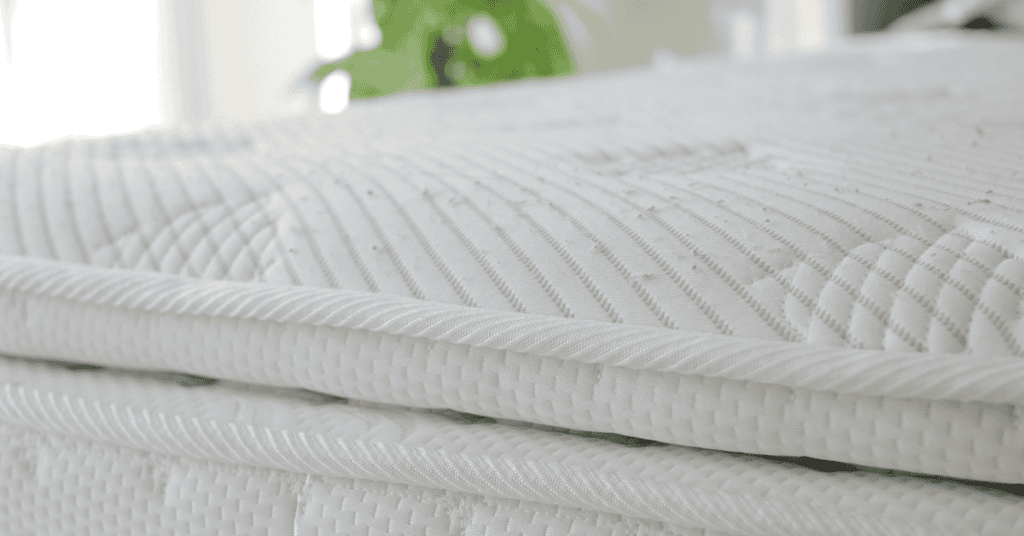
Mattresses resist fire because they are required to pass federal flammability tests before they are sold in the U.S.
The Consumer Product Safety Commission lists two mattress standards: one for smoldering ignition and one for open-flame ignition.
That means a mattress may meet the standard through:
- A built-in fire barrier
- A treated fabric layer
- Naturally fire-resistant materials
- A combination of materials inside the mattress design
A mattress can resist fire through its design, not just through added chemical treatments.
This is where confusion starts. “Meets federal flammability standards” does not automatically mean the mattress contains added chemical flame retardants.
It only means the mattress passed the required fire-safety tests.
The reverse is also true. A mattress labeled “flame retardant-free” still has to meet those rules. That claim usually means the brand says it does not use added flame-retardant chemicals.
For shoppers, the key question is not just, “Does this mattress resist fire?” It should. The better question is, “How does this mattress resist fire?”
Key Takeaway: The best question is not if the mattress resists fire, but how it does so.
Flame Retardants vs Fire Barriers
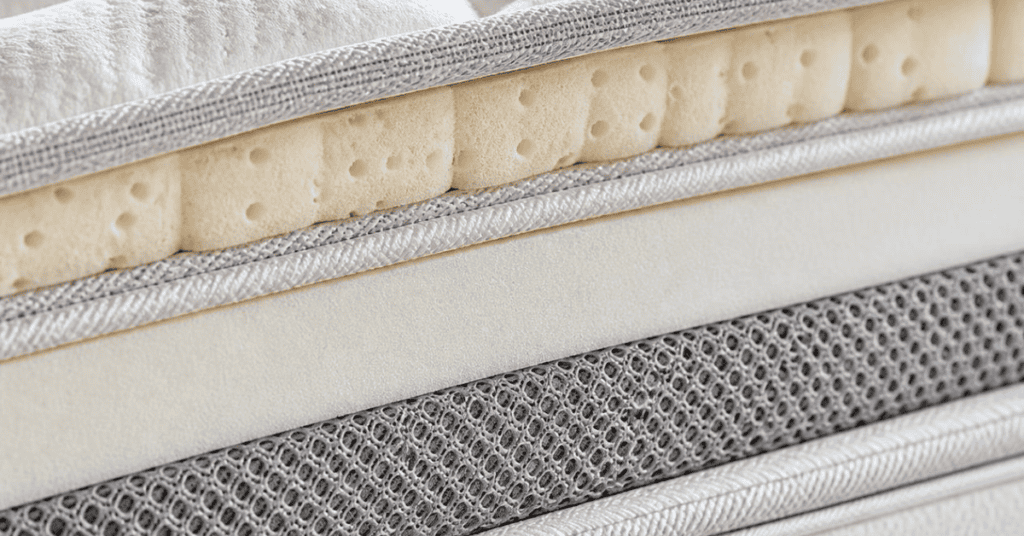
A chemical flame retardant is an added substance that slows ignition or burning. It may be mixed into foam, added to fabric, or used as a treatment on a material.
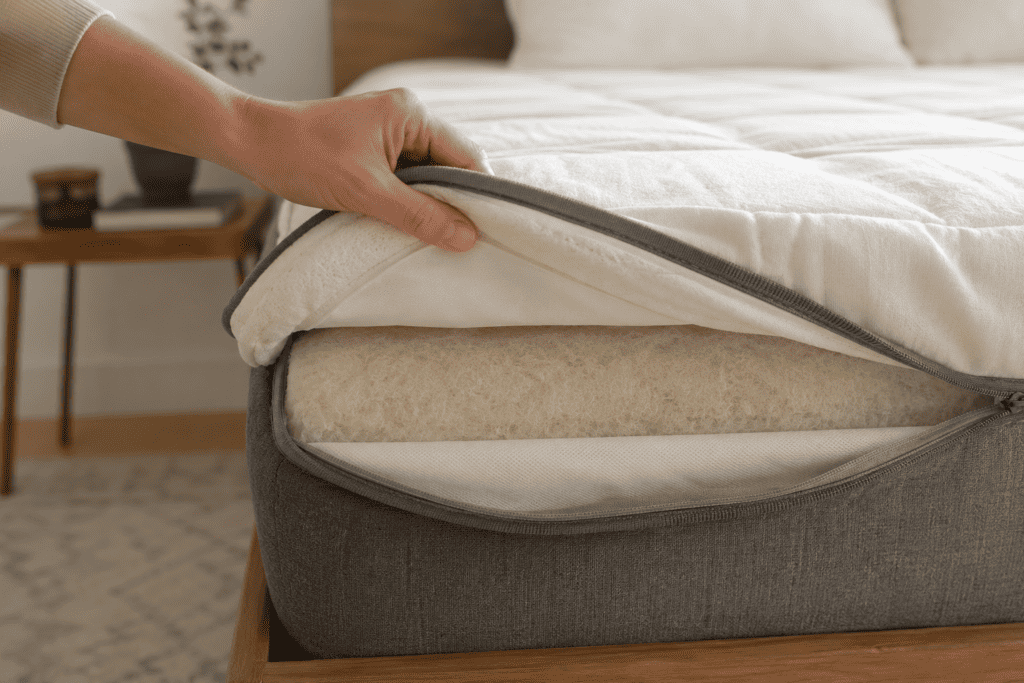
A fire barrier works more like a protective layer. It sits around the inner mattress materials and helps slow flame spread.
Common mattress fire barriers include:
- Wool, which naturally chars instead of quickly catching fire
- Silica-infused rayon, which helps form a heat-resistant layer
- Fiberglass, which can resist heat when it stays sealed inside the mattress
- Blended textile barriers, which combine fibers for fire performance
Wool, silica-infused rayon, and fiberglass resist heat in different ways. The material only works as intended when it is used correctly inside the mattress.
These materials are not all the same. Wool is often used in organic mattresses. Silica-infused rayon is common in many modern mattresses.
Fiberglass is usually chosen for mattresses because it is effective and lower cost.
Researchers study added flame-retardant chemicals because some can move out of products and collect in indoor dust.
A PubMed Central review on consumer product chemicals in dust explains that indoor dust can hold chemicals from household products, including flame retardants.
That does not mean every mattress has the same exposure issue. A sealed fire barrier is different from a chemical treatment added into foam or fabric.
Ask the brand to name the fire barrier material. A clear answer is more useful than a broad “non-toxic” claim.
Why Mattress Materials Vary
Mattress brands choose fire-safety materials based on the full mattress design.
A latex mattress, memory foam mattress, hybrid mattress, and organic mattress may all need different construction choices.
A latex mattress and a memory foam mattress may use different fire barriers because their inner materials behave differently.
The fire barrier has to work with the mattress cover, comfort layers, and support core. It also has to pass testing without making the mattress feel too stiff, hot, or noisy.
Manufacturers may choose different materials because of:
- Cost: Some barriers cost less to source and install.
- Comfort: Some materials feel softer or more breathable.
- Mattress type: Foam, latex, and hybrid beds behave differently in fire tests.
- Organic goals: Some brands use wool to support an organic or natural design.
- Durability: The barrier has to stay in place during normal use.
- Certifications: Some labels require stricter material choices.
This is why two mattresses can make similar safety claims but use very different fire barriers.
The material choice does not tell the whole story by itself. What matters is how clearly the brand explains the fire barrier and how it fits into the full mattress design.
Key Takeaway: A fire barrier should be judged by clear disclosure, not by one material name alone.
How To Read Mattress Claims

Mattress labels can be helpful, but they are often too short to explain the full design. Read claims as clues, not as complete proof.
Here is what common claims usually mean:
- “Flame retardant-free” usually means no added flame-retardant chemicals were used.
- “No added flame retardants” is more specific, but you still need the fire barrier material.
- “Fiberglass-free” means the brand says it does not use fiberglass in the mattress.
- “Meets federal flammability standards” means the mattress passed required fire tests.
- “Non-toxic” is broad. Ask what materials and certifications support the claim.
Treat label claims as a starting point. Then look for the exact fire barrier material and full material list.
Look for clear language. A helpful brand will name the fire barrier material. A vague product page may leave you guessing.
Certifications That Help
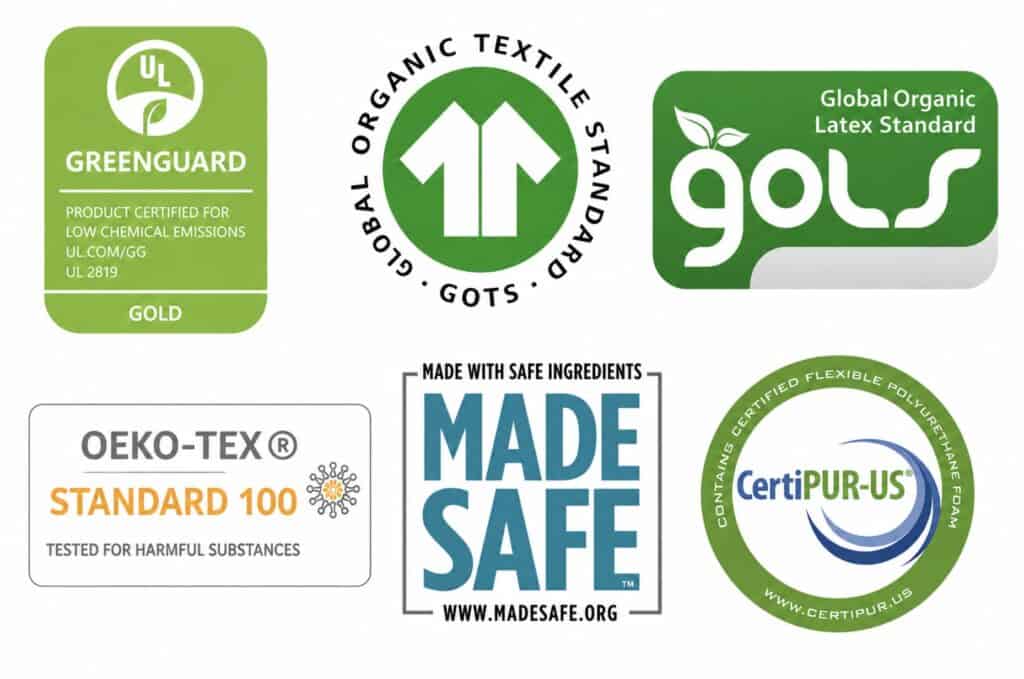
Certifications can make mattress shopping easier, but each one checks something different.
- GOTS applies to organic textiles, including some mattresses. It covers organic fibers and processing rules.
- GOLS applies to products made with organically grown natural rubber latex.
- GREENGUARD Gold focuses on chemical emissions into indoor air.
- CertiPUR-US applies to flexible polyurethane foam. It does not certify the whole mattress.
Some certifications apply to one part of the mattress, not the whole finished product.
A certification does not always explain the fire barrier. For example, a foam certification may tell you about the foam. It may not tell you what surrounds the foam.
Questions To Ask Brands
Before buying, ask simple and direct questions:
- What material is used as the fire barrier?
- Does the mattress contain added flame-retardant chemicals?
- Does the mattress contain fiberglass?
- Is the fire barrier sewn in, sprayed on, or built into the cover?
- Can I see the full material list?
- Which certifications apply to the finished mattress?
If a brand gives a clear answer, you can compare options with more confidence. If the answer is vague, keep asking before you buy.
Conclusion
Mattresses must meet fire safety rules, but that does not mean every mattress uses added chemical flame retardants.
The more useful question is how the mattress meets those rules and how clearly the brand explains its materials.
A safer-feeling choice starts with transparency.
Look for clear fire barrier details, relevant certifications, and direct answers from the manufacturer so you can choose a mattress that fits your non-toxic living priorities.