Furniture Certifications Explained: Low-Emission, Safer Materials, and Wood Sourcing Labels


Furniture certifications can make non-toxic furniture shopping feel less confusing, especially when product pages use broad claims like “eco-friendly,” “natural,” or “safe.”
These labels matter because they can show whether a product has been tested for things like chemical emissions, textile safety, foam content, wood sourcing, or broader environmental standards.
The FTC Green Guides remind brands that environmental claims should be clear and not misleading, which is why understanding what each certification actually verifies is so important.
This guide will help you read furniture labels with more confidence, without assuming any single certification tells the whole story.
Furniture certifications help identify safer furniture, but they do not guarantee perfection.
They show that a product, material, or component meets a specific standard, such as low emissions, safer textiles, tested foam, or responsible wood sourcing.
Shoppers should use certifications as helpful filters, then check what part of the furniture is certified and what materials or treatments are used.
Why Certifications Matter
Furniture certifications help you look past vague marketing words like “clean,” “green,” “natural,” or “non-toxic.”
A certification means a product, material, or component was checked against a defined standard.
That standard might focus on indoor air emissions, textile chemicals, foam content, wood sourcing, or broader environmental practices.
This matters because furniture can contain several material layers, including fabric, foam, wood, adhesives, coatings, and finishes.
Some of these materials release VOCs into indoor air, especially when the furniture is new.
An NIH-indexed review on indoor VOCs found that indoor VOC exposure has been studied in relation to respiratory health, including asthma-related outcomes.
Certifications can help you answer practical questions before buying:
- Has this product been tested for low chemical emissions?
- Was the fabric tested for certain harmful substances?
- Is the foam screened for specific flame retardants or heavy metals?
- Does the wood come from a responsibly managed forest?
- Is the brand using a third-party standard instead of only its own claims?
When shopping, look for the exact certification name and what part of the product it applies to, not just the word “certified.”
Certifications do not necessarily apply to an entire piece of furniture. In many cases, only the foam, fabric, or wood component is certified.
Sometimes the label only applies to one part, such as the foam, fabric, or wood.
The best way to use certifications is as a filter. They help you narrow your choices, then you can check the product details more closely.
For example, a sofa with a low-emission certification gives you more useful information than a sofa described only as “eco-friendly.”
Low-Emission Certifications
Low-emission certifications focus on what furniture releases into indoor air.
This usually means testing for VOCs, or volatile organic compounds. VOCs are gases that can come from paints, coatings, adhesives, finishes, and manufactured wood products.
This matters most for furniture that sits inside your home every day, especially in bedrooms, nurseries, offices, and small rooms with limited airflow.
A small, closed room can hold onto new furniture odors longer than a large, well-ventilated living room.
Research reviewed in PubMed Central explains that indoor VOC exposure has been studied in relation to respiratory symptoms and asthma-related outcomes.
Their main job is to show that a product was tested for indoor air emissions.
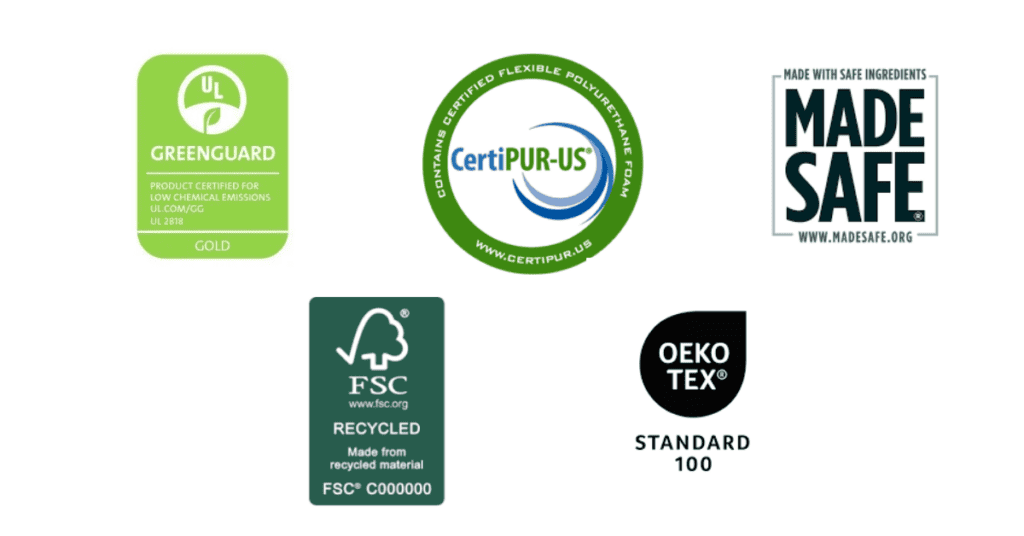
GREENGUARD and GREENGUARD Gold
GREENGUARD certification means a product has been tested for chemical emissions into indoor air.
GREENGUARD Gold uses stricter emission limits. It is often preferred for products used in schools, healthcare spaces, nurseries, and bedrooms.
You may see GREENGUARD or GREENGUARD Gold on:
- Cribs
- Mattresses
- Sofas
- Office chairs
- Desks
- Cabinets
- Shelving
- Flooring and building materials
For furniture shoppers, GREENGUARD Gold is one of the most helpful labels for indoor air quality. It tells you the product meets a defined standard for low chemical emissions.
You should still check the product page for details about flame retardants, stain-resistant treatments, and finishes.
Key Takeaway: GREENGUARD Gold is one of the most useful labels for shoppers focused on indoor air quality.
FloorScore and Indoor Advantage
FloorScore is most common on flooring. You may also see it connected to wood-based materials used in home interiors.
It focuses on indoor air emissions. This makes it useful when buying materials that cover large areas, such as flooring, panels, or built-ins.
Indoor Advantage and Indoor Advantage Gold are also indoor air quality certifications. They are often used for office furniture, building products, and commercial interiors.
These labels help when you are choosing:
- Desks
- Office chairs
- Cabinets
- Workstations
- Shelving
- Composite wood products
These labels are most useful when furniture has large manufactured surfaces or will be used in a room for long hours.
A home office desk, bedroom dresser, or nursery bookshelf may matter more than a small side table in a well-ventilated area.
These certifications help you look beyond marketing claims by showing that a product passed a specific indoor air emissions test.
Textile and Foam Labels
Textile and foam labels help you understand what is inside the soft parts of furniture.
These labels are most useful for items you touch often, such as:
- Sofas
- Armchairs
- Mattresses
- Cushions
- Upholstered beds
- Nursery gliders
- Dining chairs with padded seats
They do not always test the full furniture piece. Some apply only to the fabric. Others apply only to the foam inside the cushion.
This matters because fabrics and foam can use dyes, finishes, flame retardants, or other chemical treatments.
Some treatments stay in the material. Others can move into dust or indoor air over time.
OEKO-TEX and GOTS
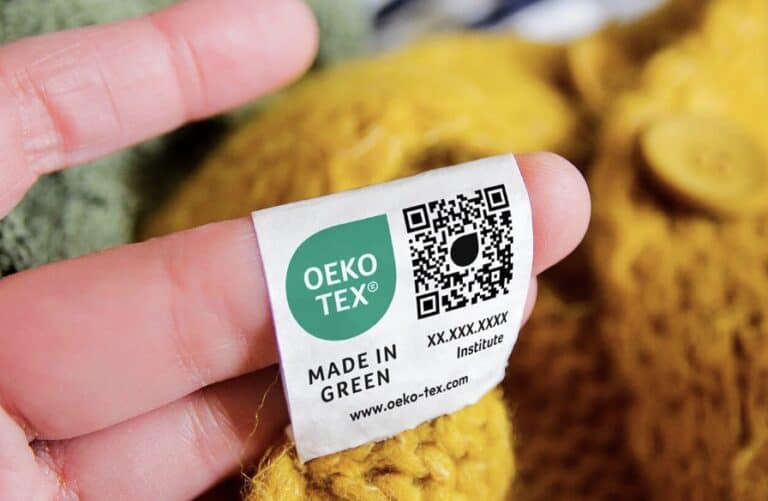
OEKO-TEX Standard 100 is a textile label. It means the fabric or textile component was tested for certain harmful substances.
OEKO-TEX says the standard applies from yarn to finished textile products.
For furniture, this label is most helpful when you are checking:
- Upholstery fabric
- Cushion covers
- Mattress covers
- Decorative pillows
- Removable textile pieces
OEKO-TEX does not mean the fabric is organic. It also does not automatically tell you how the wood, foam, frame, glue, or finish was made.
GOTS stands for Global Organic Textile Standard. It applies to textiles made with organic fibers. GOTS also includes environmental, human-rights, and social criteria across the textile supply chain.
For furniture shoppers, GOTS is most useful when the product uses cotton, wool, or another textile fiber. It tells you more than “organic fabric” alone.
GOTS does not certify every part of a sofa or chair. If only the fabric is GOTS certified, ask what is inside the cushion and frame.
If a product says the fabric is certified, check whether the cushion, frame, and finish have separate details.
CertiPUR-US and MADE SAFE
CertiPUR-US applies to flexible polyurethane foam. This is the foam often used inside cushions, mattresses, and upholstered furniture.
CertiPUR-US certified foam is made without formaldehyde, certain phthalates, ozone depleters, and heavy metals such as mercury and lead.
It also has a low VOC emissions limit of less than 0.5 parts per million.
This label can help when you are buying furniture with conventional foam. It tells you the foam was screened against specific substances.
CertiPUR-US does not mean the foam is natural. It also does not certify the fabric, frame, stain treatment, or finished furniture piece.
CertiPUR-US applies to polyurethane foam, not the entire sofa, chair, or mattress.
MADE SAFE is broader. It screens products for ingredient safety with a focus on human health and ecosystems.
When available, MADE SAFE can give shoppers more ingredient-level information than a foam-only label.
It is not as common on furniture, so you may see it more often on mattresses, bedding, or select home goods.
Use these labels as part of the bigger picture:
- OEKO-TEX: helpful for tested textiles
- GOTS: helpful for organic textile materials
- CertiPUR-US: helpful for polyurethane foam
- MADE SAFE: helpful for broader ingredient screening
For upholstered furniture, the strongest choice is usually a combination of labels. A sofa may have OEKO-TEX fabric, CertiPUR-US foam, and a separate low-emission certification.
Wood and Sourcing Standards

Wood certifications focus on where wood comes from and how forests are managed.
You may see wood sourcing labels on:
- Dining tables
- Bed frames
- Dressers
- Cabinets
- Bookshelves
- Desks
- Wooden chairs
The main labels to know are FSC, PEFC, and SFI.
FSC stands for Forest Stewardship Council. FSC says its system connects responsible forest management with certified and labeled products shoppers can recognize.
PEFC stands for Programme for the Endorsement of Forest Certification.
PEFC explains that certification helps trace forest and tree-based products from sustainably managed forests through the supply chain.
SFI stands for Sustainable Forestry Initiative. SFI standards include forest management, fiber sourcing, and chain-of-custody certification, with audits by independent certification bodies.
These labels are helpful when you want wood that comes from a more traceable forest source. They are especially useful for solid wood furniture and products with visible wood components.
Composite wood needs a separate check. This includes particleboard, MDF, and hardwood plywood.
In the United States, the EPA says composite wood products must be labeled as TSCA Title VI compliant, which addresses formaldehyde emissions from those materials.
Formaldehyde matters because some pressed wood products use resins that release formaldehyde into indoor air. For shoppers, this means wood sourcing and formaldehyde compliance answer two different questions:
- FSC, PEFC, or SFI: Where did the wood come from?
- TSCA Title VI: Does the composite wood meet U.S. formaldehyde emission rules?
- Low-emission labels: Was the finished product tested for indoor air emissions?
For wood furniture, check both sourcing and emissions. A responsible wood label and a low-emission label answer different questions.
A wooden dresser may have an FSC-certified frame, MDF drawer bottoms, and a painted finish. In that case, the FSC label helps with sourcing.
You still need to check for TSCA Title VI compliance and any low-emission certification.
For safer furniture shopping, use wood sourcing labels as one part of the decision. They are strongest for forest responsibility.
Broader Safety Standards

Some furniture labels go beyond one material or one emission test.
These standards may look at product safety, durability, chemical screening, environmental impact, or manufacturing practices.
They are most common on office furniture, children’s furniture, institutional furniture, and products made for stricter purchasing programs.
They are useful because they answer bigger questions, such as:
- Was the product tested for strength or durability?
- Does the standard review several environmental factors?
- Are certain restricted chemicals screened out?
- Does the company follow a broader sustainability framework?
- Does the product meet a required safety rule?
These labels do not all measure the same thing. Some are certifications. Some are testing standards. Some are legal requirements.
BIFMA is common in office and commercial furniture.
The BIFMA LEVEL program evaluates furniture against the ANSI/BIFMA e3 Furniture Sustainability Standard, which includes criteria for materials, energy, human health, ecosystem health, and social responsibility.
This can help when buying desks, office chairs, workstations, and commercial seating. It does not automatically mean every material is natural or untreated.
Cradle to Cradle Certified looks at products through a wider sustainability lens.
Its standard includes categories such as material health, product circularity, clean air and climate protection, water and soil stewardship, and social fairness.
For furniture, this label can help shoppers find products designed with safer materials and better environmental practices. It is broader than a simple “low-VOC” label.
GreenScreen Certified is more focused on safer chemistry.
For furniture and fabrics, GreenScreen says certified products are PFAS-free, use safer chemistry, and meet specifications used in healthcare purchasing.
PFAS are discussed in health and environmental research because they break down slowly.
TSCA Title VI is not a voluntary wellness label. It is a U.S. federal rule for formaldehyde emissions from composite wood products.
This matters for items made with MDF, particleboard, or hardwood plywood.
CPSC and ASTM safety standards focus on physical safety. For example, the CPSC adopted a mandatory safety standard for clothing storage furniture to reduce dresser and chest tip-over injuries.
That kind of rule does not tell you whether a dresser is low-emission. It tells you the product must meet a safety requirement for stability.
Use broader standards to understand the bigger picture:
- BIFMA LEVEL: helpful for commercial furniture sustainability and performance
- Cradle to Cradle: helpful for broader material and environmental goals
- GreenScreen Certified: helpful for PFAS-free and safer chemistry claims
- TSCA Title VI: required formaldehyde limits for composite wood
- CPSC/ASTM standards: physical safety and product testing
Key Takeaway: Broader standards are most helpful when you want to understand safety, durability, sustainability, and chemical screening together.
They still need to be matched to the furniture type you are buying.
What Labels Miss
Certifications are helpful, but most apply only to specific materials, components, or performance standards.
Understanding what a certification does not cover is just as important as understanding what it does cover.
A label may not guarantee that:
- The entire furniture piece is certified
- Every material was tested
- The product is chemical-free
- The brand discloses all treatments
- The finish, adhesive, or stain was reviewed
- The product will have no smell when it arrives
- The furniture meets every buyer’s personal comfort level
When a product has a certification, ask what part is certified. The answer may be the fabric, foam, wood, or finished product.
Some labels apply only to one part of the product. For example, a foam certification may apply to the cushion filling, but not the fabric.
A textile certification may apply to the cover, but not the frame or padding.
This matters most with layered furniture. Sofas, mattresses, upholstered beds, recliners, and nursery chairs often combine several materials. One certification can answer one question, but it may not answer all of them.
Labels can also miss added treatments. A fabric may be tested for certain substances, but the product page may not clearly explain whether it has stain resistance, water resistance, or antimicrobial treatment.
PFAS are often discussed in relation to stain-resistant and water-resistant treatments.
The CDC explains that some PFAS stay in the body for years, so shoppers may want to ask brands whether treated fabrics are PFAS-free.
Also check whether a claim is certified or simply marketing language. Words like “eco,” “clean,” “green,” and “non-toxic” are not the same as third-party testing.
A stronger product page should explain:
- Which certification applies
- What part of the product is certified
- Which materials are used
- Whether flame retardants are added
- Whether stain-resistant treatments are added
- What finish or adhesive is used
- Whether testing documents are available
If the brand does not explain these details, ask before buying. A clear answer is part of safer shopping.
The goal is not to find a perfect label. The goal is to use labels as a starting point, then check the product details that the label does not cover.
Most Useful Certifications
The most useful furniture certification depends on what you are trying to avoid or verify.
Start with your main concern first. Choose indoor air labels for emissions, textile labels for fabric, foam labels for cushions, and wood labels for sourcing.
At The Goodness Well, we look at certifications as helpful clues, not the whole story.
Best for Indoor Air
Choose indoor air certifications when the furniture will stay in a bedroom, nursery, home office, or small room.
These labels are most helpful for new furniture that may release VOCs from finishes, coatings, adhesives, or manufactured surfaces.
Helpful labels include:
- GREENGUARD Gold: Best known for stricter chemical emissions limits.
- GREENGUARD: Helpful for basic low-emission screening.
- Indoor Advantage Gold: Useful for office furniture and commercial interiors.
- FloorScore: Most common for flooring and some interior materials.
If you are choosing furniture for a child’s room, start here. Indoor air labels give you the clearest information about what the product releases into the room.
Best for Materials
Choose material-focused labels when you want more information about fabric, foam, or fiber content.
These labels are most helpful for furniture you touch daily. This includes sofas, lounge chairs, mattresses, padded dining chairs, and upholstered beds.
Helpful labels include:
- GOTS: Best for organic textiles, such as cotton or wool.
- OEKO-TEX Standard 100: Helpful for textiles tested for certain harmful substances.
- CertiPUR-US: Helpful for flexible polyurethane foam used in cushions and mattresses.
- MADE SAFE: Helpful when available, because it screens ingredients more broadly.
Use these labels to understand what part of the product was reviewed. For example, CertiPUR-US tells you about the foam. It does not tell you about the upholstery fabric.
Best for Sustainability
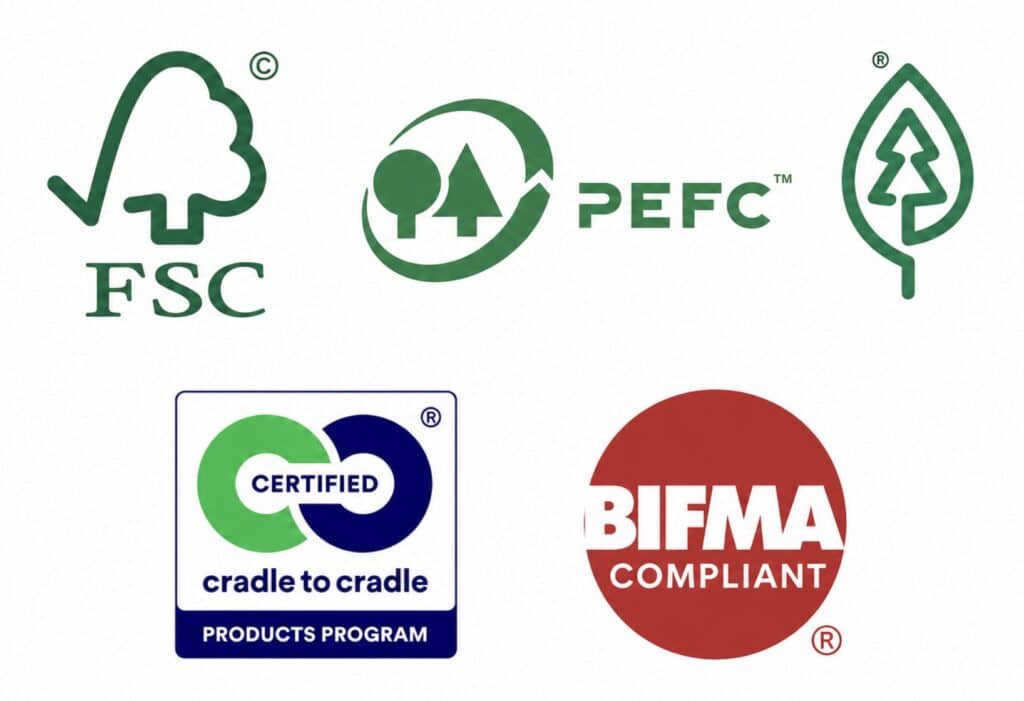
Choose sustainability labels when you want to know more about forest sourcing, circular design, or environmental practices.
These labels are most helpful for solid wood furniture, wood-based furniture, and brands making broader environmental claims.
Helpful labels include:
- FSC: Best known for responsible forest management.
- PEFC: Helpful for certified forest and tree-based products.
- SFI: Common for certified forestry and fiber sourcing.
- Cradle to Cradle Certified: Helpful for broader material and environmental review.
- BIFMA LEVEL: Useful for office and commercial furniture.
These labels answer different questions than low-emission labels. A wood product can be responsibly sourced and still need separate checks for finish, formaldehyde compliance, or indoor air emissions.
For most shoppers, the strongest approach is to combine labels. Look for one certification for indoor air, one for the main material, and one for sourcing when wood is involved.
The strongest furniture choice often has more than one useful label, plus clear product details from the brand.
How to Shop Smarter

Certifications work best when you use them with product details.
Start with the furniture type. A solid wood side table needs different checks than an upholstered sofa or a crib mattress.
Use this simple process before buying:
- Start with the main material
Look at what the furniture is made from first. Check whether it uses solid wood, composite wood, metal, fabric, leather, latex, or polyurethane foam. - Match the certification to the concern
Use low-emission labels for indoor air. Use textile labels for fabric. Use foam labels for cushion filling. Use wood labels for sourcing. - Check what part is certified
A product page may say “certified,” but the label may apply to only one component. Look for wording like “certified fabric,” “certified foam,” or “certified finished product.” - Ask about added treatments
For upholstered furniture, ask whether the fabric has flame retardants, PFAS-based stain resistance, antimicrobial treatments, or water-resistant coatings. The CDC explains that some PFAS can remain in the body for years, so PFAS-free fabric claims are worth checking. - Check finishes and adhesives
For wood furniture, ask what finish, stain, paint, or adhesive was used. This matters most with painted furniture, sealed wood, and composite wood pieces. - Prioritize low-emission labels indoors
For bedrooms, nurseries, and home offices, look first for GREENGUARD Gold, GREENGUARD, Indoor Advantage Gold, or similar low-emission testing. - Ventilate new furniture
Open windows when possible after delivery. Let new furniture air out before placing it in a small bedroom or nursery. - Look for clear brand answers
A safer furniture brand should explain its materials clearly. If a brand gives vague answers, keep looking or ask for testing documents.
A good product page should make your decision easier, not harder. You should be able to tell what the item is made from, which certifications apply, and what treatments were added.
When two products look similar, choose the one that gives clearer answers about materials and certifications.